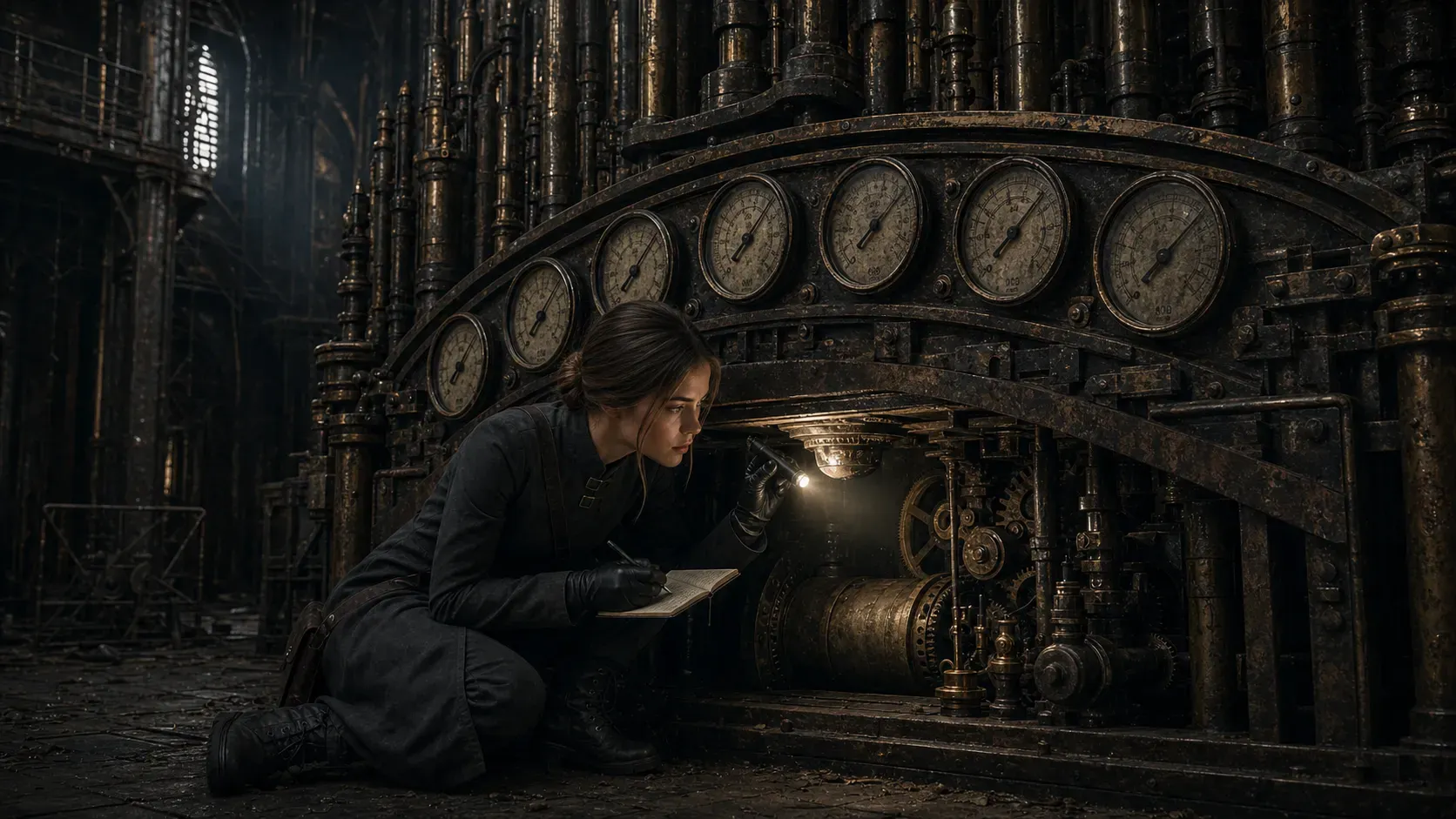
Before she approached the altar, she stopped to prepare herself — a habit from her first year on the job, when haste had nearly cost her two fingers in the trap of an old press. She pulled on black gloves. The photographs from the cache stayed in her coat's inner pocket, close to her body, as if the warmth of her skin could protect them.
At the end of the nave — the altar, though no priest had dared call it that while the foundry still lived: a central pressure regulator, four meters tall, six pressure-gauge dials arranged in an arc, pipes like organ pipes. In its forged-iron base — a clockwork mechanism, an hourly caliber, a steam-distribution sequencing system. Achen & Sons, Bremen, series 1872–1878, withdrawn from the market after the Rotterdam catastrophe.
The same model. The same series. She recognized the shape of the gauge dials before she'd even come closer.
The caliber was running. The central drum turned slowly, without a jolt. Oil dripped from the feeder — not congealed, fresh. Someone had been servicing the mechanism. Recently. Maybe today.
She crouched. On the calibration dial, engraved on the underside, a string of digits. Not a serial number. A sequence: seven groups, varying lengths, irregular spacing. She took out her notebook, copied each group separately, then checked them against the list of Westergaard personnel service numbers — one item from the eighteen-month archive — which she carried sewn into her coat lining.
Six groups matched nothing she had. The seventh —
A service number. A name beside it, written in a small, official hand from years ago: Halvard Riis. Shift Supervisor.
Maren's hand went still over the notebook. She took out the photograph from the cache — the man in uniform, the badge worn smooth in the same spot where her finger now rested on the list. The number matched. Not entirely — the last two digits erased by years of touch — but the rest was identical.
I still haven't finished counting.
Suddenly the sentence meant more than she could bear all at once. She put the photograph away, closed the notebook, stood up.
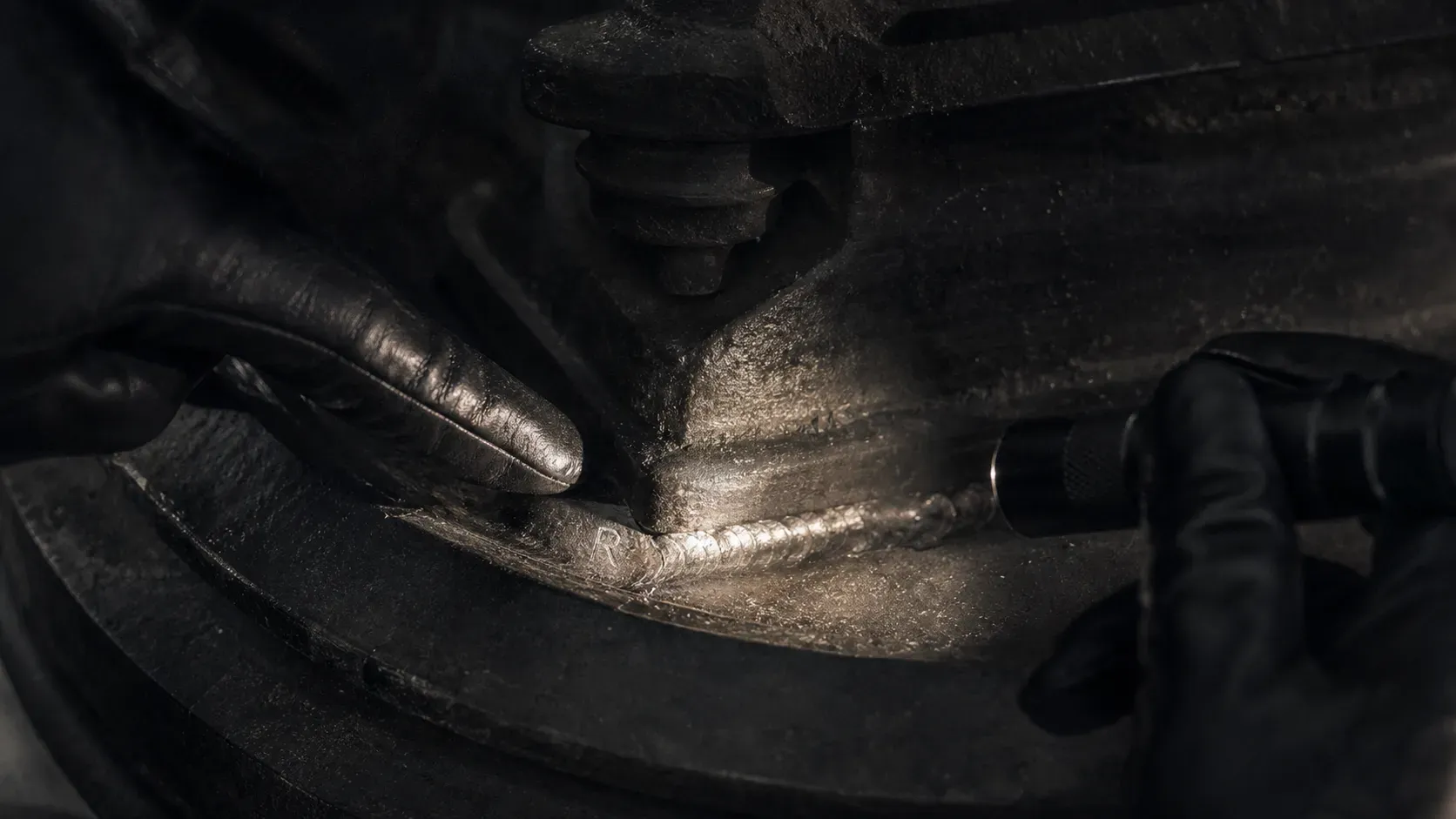
Her eyes returned to the base of the caliber — not the dial, but the forged-iron structure itself. Along the edge ran a weld of a different steel than the rest of the casting — brighter, newer, layers laid down like tree rings. At least four cycles of opening and re-welding. She set that aside for later — something stronger than professional instinct told her the answer waited deeper.
She circled the regulator, hunting for an entrance with her feet, not her eyes. An industrial cathedral, like any building designed by engineers raised in the sacred tradition, had crypts. Beneath altars, they built graves.
She found the hatch eight paces from the regulator's base, masked by a mosaic of copper and brass tiles: a gear ringed by six smaller ones. A caste mark, not a company one — reserved for the highest tier of engineering personnel.
The hatch wasn't locked. Its weight served as lock enough. She wedged a crowbar into the gap, pulled. The hatch rose with a groan of hinges someone had oiled recently.
Below, a spiral stairway, cut directly into the bedrock. Air rose from the opening carrying the same smell she'd registered since the cathedral's threshold — ozone and greased steel — but denser.
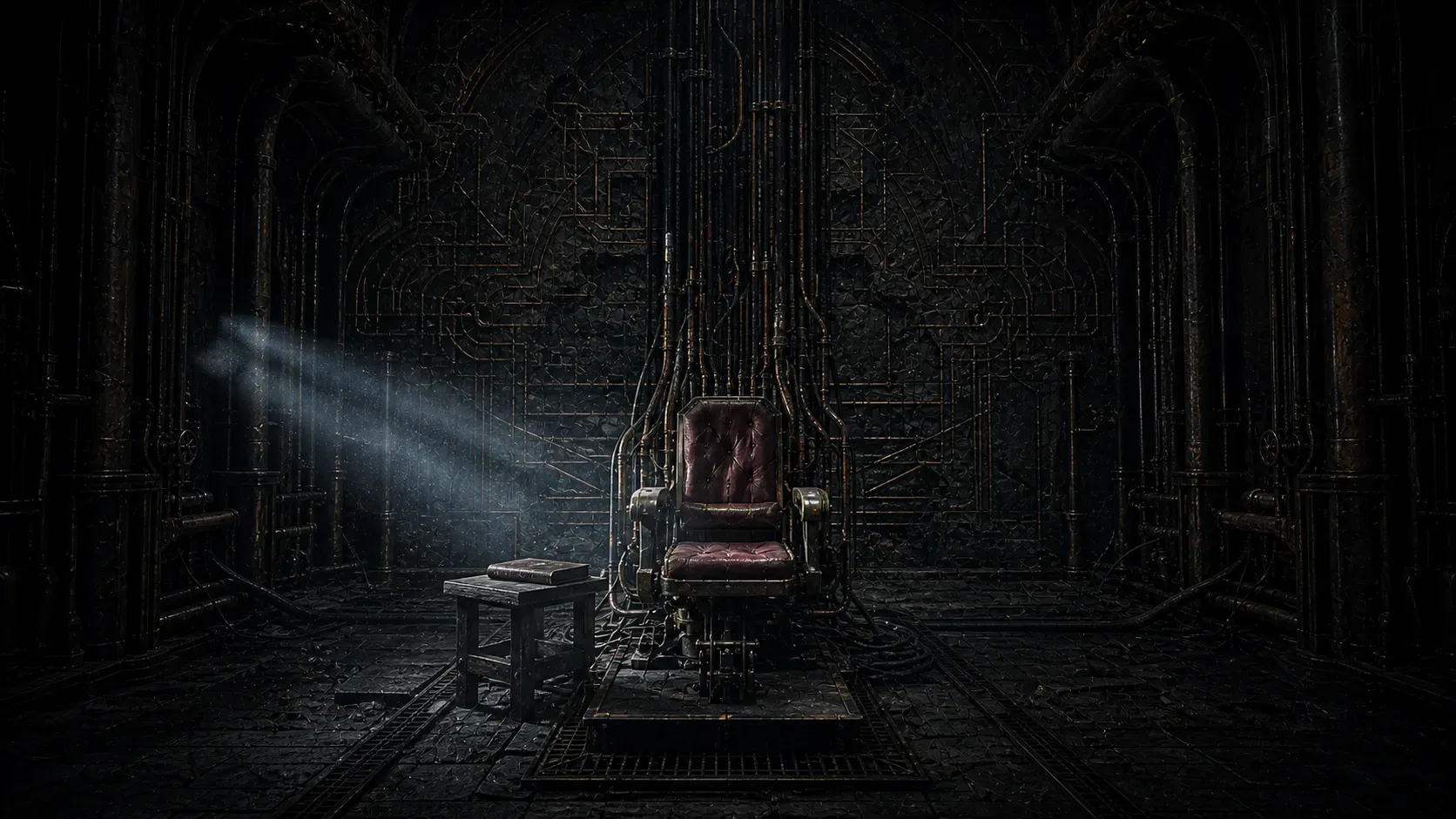
She descended, counting the steps, because counting was her way of holding fear at a distance. Thirty-two. The walls — basalt inlaid with veins of copper arranged into technical diagrams: pressure flows, distribution points. A schematic for a system that, judging by the scale of the drawing, spanned the whole industrial quarter.
The chamber below had no right to fit under a building this size, and yet it did. The cathedral over her head wasn't the only structure in this complex. It was the summit.
At its center stood a chair — upholstered in worn wine-colored velvet, armrests reinforced with brass fittings, ringed by a thicket of pipes wired straight into its frame, like veins running from a heart. Cables climbed the wall to the vault, where they vanished into an opening leading, she suspected, directly to the caliber's base.
The chair was empty. The velvet on the backrest bore an impression the shape of a back — fresh, still holding the memory of pressure.
Beside the chair, on a low table, lay a notebook bound in leather worn so thin it had begun to resemble suede. She opened it carefully.
A technical hand, cramped, economical — flow diagrams, pressure calculations, entries dated not by years of the New Reckoning but by consecutive day-counts, as if the author had stopped trusting the calendar. Among the calculations, fragments of sentences that were no longer engineering.
Rotterdam was not a construction failure. It was a failure of assumption. We believed the body could tell its own pain from the machine's. Twenty-six people taught me we were wrong, in four minutes, all at once.
The caliber is not a punishment. It is a way not to forget the names the Contract has already forgotten.
Seven. Not a hundred and forty-seven. I couldn't carry all of them at once. I started with the ones I knew by name.
This wasn't the diary of a madman. It was the diary of someone who had turned grief into engineering, because engineering was the only language he could still speak without screaming.
The last entry, fresher than the rest, the ink darker:
Someone was here. Not the Contract — those who come in its name don't hide. Someone searching the way I once searched. Maybe it's finally time for someone else to finish the count.
She closed the notebook. Her hands, despite the gloves, were cold.
She stood, started toward the stairs, but something made her stop by the chair once more, let her eyes travel the cables up to the vault. She climbed back up, counting the steps in reverse, and knelt a second time at the regulator's base, this time with the notebook's contents — which, she suspected, belonged to him — still fresh in her mind.
She ran her hand along the newest weld — sharp edges, weeks old, maybe days — and this time, with the flashlight held low, almost parallel to the metal, the light fell at an angle she'd missed before. A shadow. Not a welding flaw. A letter, carved into the metal just beside the seam.
R.
She thought about the weld's four cycles. About four moments when someone had opened this base and could have, she believed, stopped the turbine's heart for good — and instead closed it again, leaving a trace of his presence, as if signing not the work, but the hesitation.
Her fingers went still on the metal.
Behind her, from the direction of the stairs, came the sound of footsteps.
Rather listen? This chapter as audio →