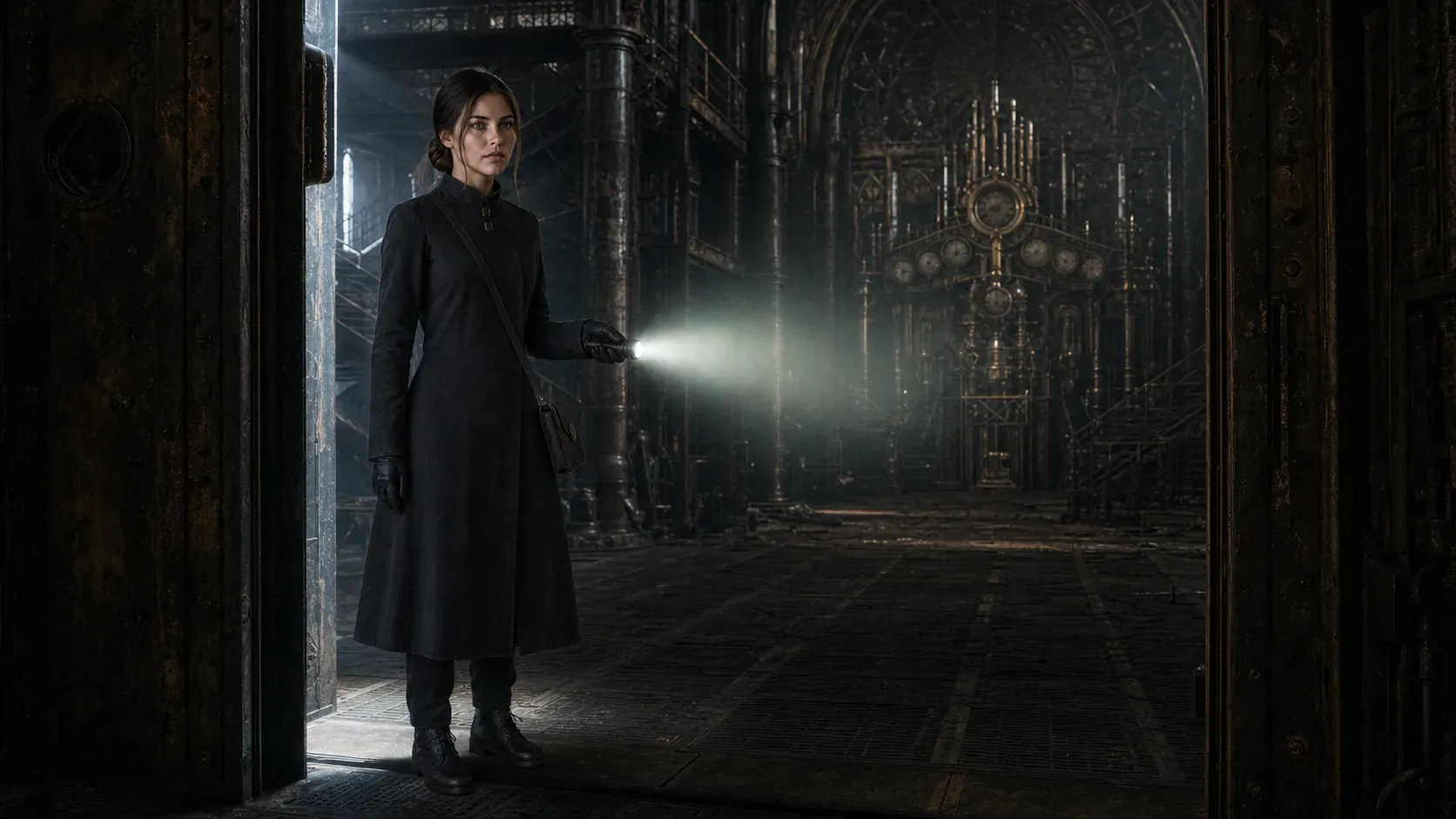
Before the first word about the cathedral, there was the archive.
For eighteen months Maren had been buying fragments of the Imperial Energy Contract's past — insurance files, correspondence, witness statements taken down by notaries no one paid for silence anymore. She did it because eighteen years earlier the Contract had taken her father and given back an iron service token and one sentence in a closed-case report: death by technical failure, cause undetermined.
She had been ten years old. She didn't remember the face of the clerk who brought the news to the door. She remembered his hands — clean, no trace of grease, the hands of a man who had never touched the machine he spoke of.
The Contract. That was what they called it in the harbor bars, always with a small hesitation before the word. A monopoly that had built and steam-powered half the cities of the North before it fell with the rest of the empire. Its agreements carried survivorship clauses — passed to heirs, to creditors, to faceless structures. Fear had had time to become a habit.
Maren's father worked as a second-shift technician at the Rotterdam plant — off to the side, where the emergency valves were calibrated, far from management's spotlights. He was there the day a hundred and twelve people died during the trial of a system the Contract had never officially mentioned: the Symbiosis Program.
She first heard the name not from the files but from the mouth of a drunk mechanic in the harbor, a good ten years after Rotterdam — he repeated the word like a prayer he was afraid of. She walked him out of the bar, paid him for his silence with everything she had on her, and wrote down every word. That was the first piece of the puzzle. The rest took her another eight years.
The Westergaard cathedral was the second attempt — she'd known that for a long time, though she'd spent months hunting for proof. In the end, one aerial photograph convinced her, in which the Westergaard chimney, supposedly cold for four decades, stood out against the sky in a narrow thread of heat — invisible to the naked eye, visible to a camera tuned for infrared. Rotterdam had taught her one thing for certain: the Contract never destroyed what it had invested in. It hid it.
That night she wasn't hunting a relic to sell. She was hunting proof that her father hadn't died from a "technical failure, cause undetermined" — that someone had known beforehand what would happen, and let it happen.
The chimney hadn't smoked in forty years.
And yet — when she crossed the threshold — the turbine's heart was beating. One pulse every nearly two minutes. Barely audible through three floors of dead steel. But it beat. Steady. Without hesitation.
The Westergaard cathedral — in the registers, Industrial Site No. 7 — wore two faces. The first: a brass foundry, a pillar of the Imperial Contract. The second: a grave. A hundred and forty-seven victims in a ventilation explosion. Sealed. Forgotten.
She stood in the threshold longer than she'd planned. Months of tracking had brought her to a door the city officially didn't see — and now she felt something she hadn't anticipated. Not triumph. Recognition. The same smell, the same density of air — she remembered them from the day she'd seen the one photograph of the Rotterdam plant she had ever seen.
She didn't go straight to the main nave. She turned aside first, to a row of empty niches along the wall, where in a sacred building confessionals would have stood — here they had once served the shift foremen.
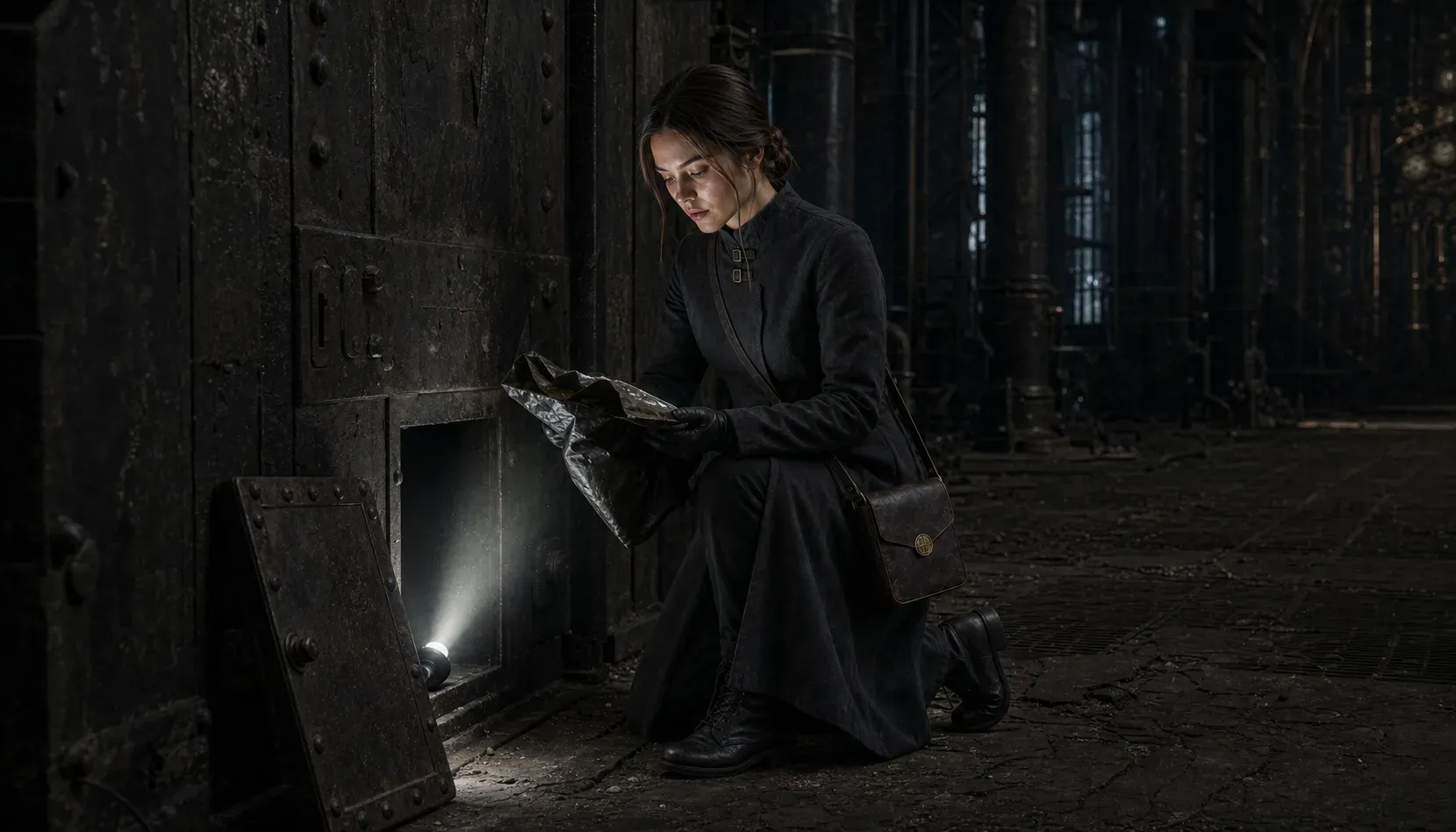
The third niche from the left had, in its back wall, a panel unlike the others — not basalt but wood, fitted so carefully that only someone who looked with their fingers, not their eyes, would find it. Maren looked with her fingers. Always.
She pressed the corner of the panel. The wood gave without resistance — too smoothly for something no one was meant to have touched in years — revealing a cavity as deep as a forearm. Inside, wrapped in oil-treated cloth, lay a long, narrow parcel.
Photographs. On top — a man in a shift supervisor's uniform, face severe, a badge on his chest with a service number worn smooth by touch, as if someone had come back to the photograph with a finger, year after year, always in the same spot. She didn't recognize the face. She had no reason to, not yet.
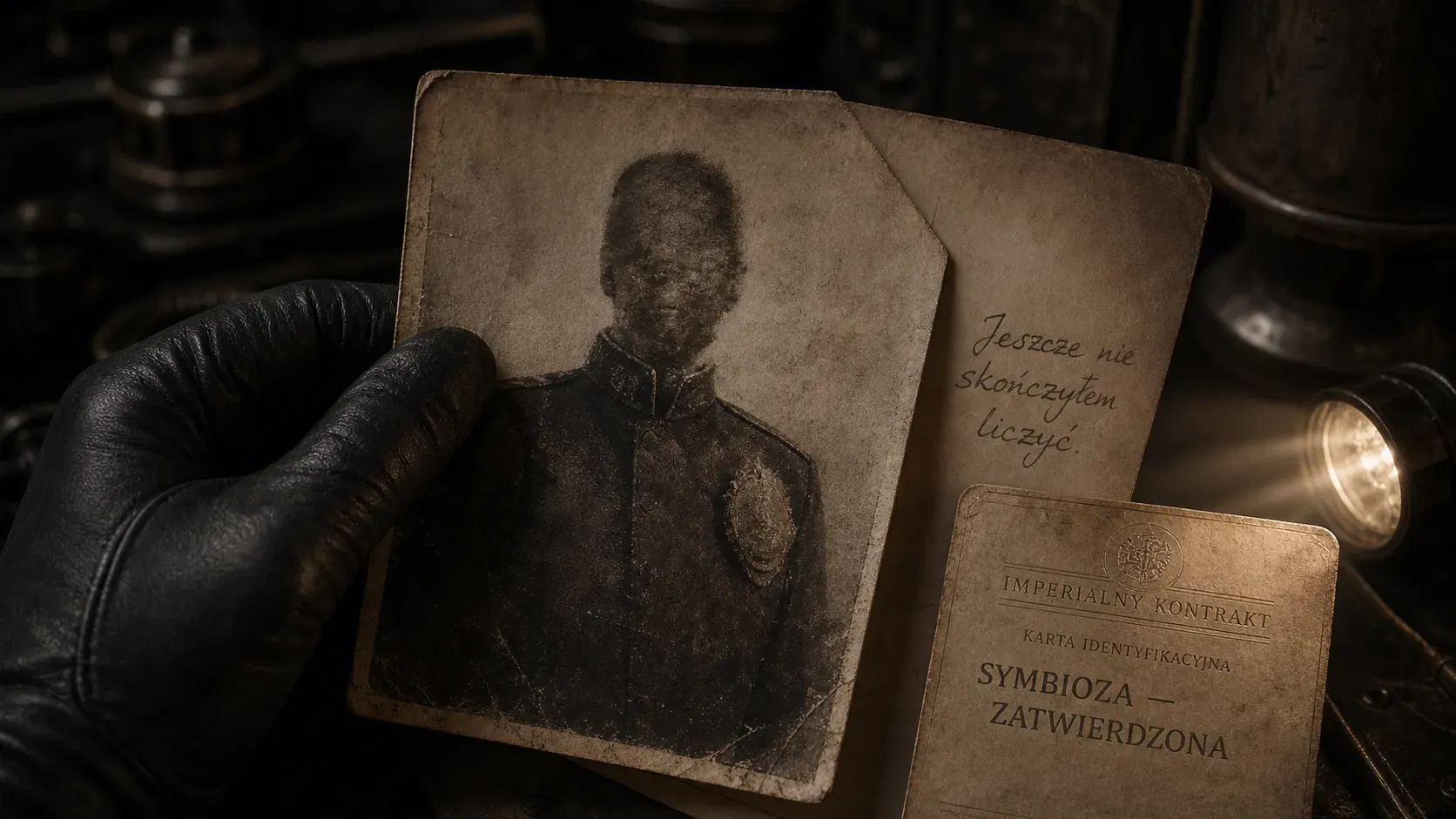
A date in the corner: two days before the Rotterdam catastrophe.
Beneath the photograph, an identification card with the Contract's embossed header. In the field reserved for medical notations, one word: Symbiosis — approved.
Something tightened in her — not fear, something older and colder. The same program. The same man whose voice a drunk mechanic had tried to drown in beer, ten years ago.
On the back of the photograph, a note in a different hand, fresher, as if someone had returned to this card again and again over the years:
I still haven't finished counting.
It wasn't addressed to her. Unless the author had written it to himself, in moments when he needed reminding that some account still waited to be closed.
She tucked the photographs into her coat's inner pocket. The panel slid back into place with a quiet knock of wood on wood.
Someone had prepared this cache meaning for Maren to find it one day. Not by chance — with the same care one gives a mechanism meant to outlive its maker.
This was only the threshold. The cache was merely an invitation — the first page of a document whose rest lay further in, in a darkness she hadn't reached yet.
She moved toward the main nave.
Rather listen? This chapter as audio →